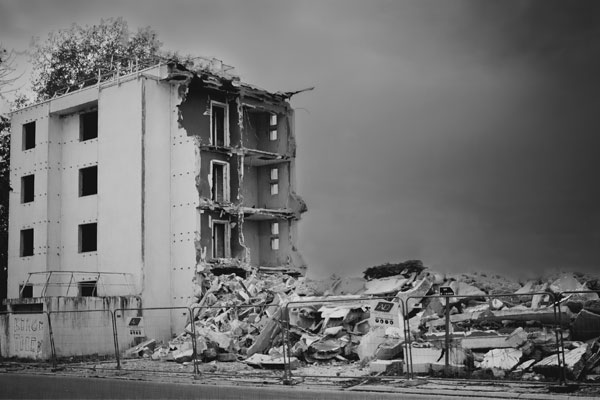
Earthquakes have killed more people than any other geophysical hazard — not because the shaking itself is deadly, but because of what it brings down on top of us.
Why earthquakes are so lethal
On the morning of January 23, 1556, the deadliest earthquake in recorded history struck Shaanxi province in China. An estimated 830,000 people died — many in cave dwellings carved into soft loess cliffs that collapsed instantly.
Unlike hurricanes or floods, earthquakes give virtually no warning. A megathrust rupture releases energy accumulated over centuries in seconds, and the secondary hazards — collapsing masonry, fires, landslides, tsunamis — are often deadlier than the shaking itself.
“It is not the earthquake that kills you. It is the building.”
Reading the magnitude scale
The moment magnitude scale is logarithmic: each whole number represents roughly 32 times more energy released. A magnitude 9.0 — the kind Cascadia is capable of — unleashes nearly a thousand times the energy of a magnitude 7.0.
That is why the difference between a “major” and a “great” earthquake is so stark, and why modern building codes have done more to save lives than almost any other intervention.
The fault under your feet
The Cascadia Subduction Zone last ruptured on January 26, 1700 — a magnitude-9.0 event that sent a tsunami across the Pacific to Japan. These full-margin ruptures recur roughly every 300–500 years, and we are now 326 years into that window.
For Portland residents the threat is twofold: violent shaking lasting up to five minutes, and — for the coast — a tsunami arriving in as little as 15 minutes. Inland Portland won't flood, but unreinforced masonry and liquefaction-prone soils along the Willamette pose serious risk.
What survival actually requires
After a Cascadia rupture, emergency services in the Portland metro could be overwhelmed for days to weeks. Bridges may be unusable, water mains broken, and the grid down. FEMA's guidance for the region is unusually blunt: prepare to be self-sufficient for a minimum of two weeks.
That means water, food, sanitation, and a plan to reconnect with family when cell networks fail. The checklist beside this article is the exact framework our editors use to evaluate readiness.